 overview & history cost & benefits development issues rails with trails canal towpath trails design of trails resources |
 |

|
|

Walking to work? Headed out for a leisurely stroll? Probably the last place you'd expect to take a quiet, safe walk is a railroad. And you shouldn't—that is, if the rail is still actively traveled by trains.
But the rise of the automobile and the development of the interstate system left in their dust over 150,000 miles of unused railroad lines. And since as early as 1939, the corridors left behind by the railroads have been transformed into safe, friendly paths for pedestrians and bicyclists. It's called the rails and trails movement, and all across the country, it's a huge success.
Today, in many communities, the most popular places to walk and bicycle are away from the road and highway system on separate paths or trails. Off-road facilities such as these provide a relatively low-stress environment for bicycling, walking, in-line skating and other activities, while also providing direct access between homes, work places, shops and other destinations.
Known as trails or shared use paths (or sometimes just as "bikepaths"), these facilities may use old rail lines, river corridors, canal towpaths, or other "greenways" to get commuters, joggers, recreational riders, dog-walkers and wheelchair users where they want to go.
While rail-trails cannot replace streets and sidewalks, the conversion of the extensive network of disused or abandoned railroads in communities throughout the United States nicely supplements the traditional roadway system of on-road bike lanes, wide outside lanes, paved shoulders and bike routes.
Thinking of launching a rail-trails program in your community or improving an existing trail? Look here for information about the benefits rails and trails bring, greenway design, the developmental issues of community concerns, ownership, cost, property value, liability, crime, and more.

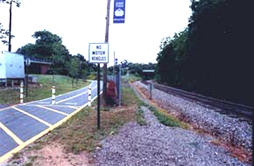 A shared use path and an active rail line. |
The reasons why are easy to see. Rail corridors are straight, have gentle grades, and connect communities and the countryside. They provide a traffic-free environment where users can enjoy scenic views, get close to nature, rediscover the past, and gain access to downtown shopping, industrial areas, and new developments alike. Most importantly for transportation planners, the corridor is already in place and does not have to be pieced together as it would if the path were created from scratch.
Rail-trails offer a great many advantages to bicyclists and pedestrians, and also to the communities through which they pass. However, the development and design of rail-trails often take many years to complete.
In recent years, there has been a lot of interest in the possibility of having shared use paths run alongside active rail lines, with adequate separation and protection against trespassing, and on canal towpaths which share many of the same characteristics as railroad corridors.
Many of the best communities for bicycling and walking in the United States feature rail-trails as the backbone of their facility networks.
- Burke Gilman Trail (Seattle)
- Capital Crescent (Washington, DC)
- W&OD (Washington DC)
- Boston's Minuteman Trail (Boston)
- Pinellas Trail (Tampa)
- Iron Horse Trail (San Francisco)